Let’s be real. If you’re working with AI tools every day, you’ve hit the wall. You know the feeling: you need that perfect output, but you spend 20 minutes tweaking the prompt you used last week because you forgot exactly what made it great. You’re suffering from Prompt Fatigue. It’s inefficient, it’s frustrating, and honestly, it’s a waste of your professional time.
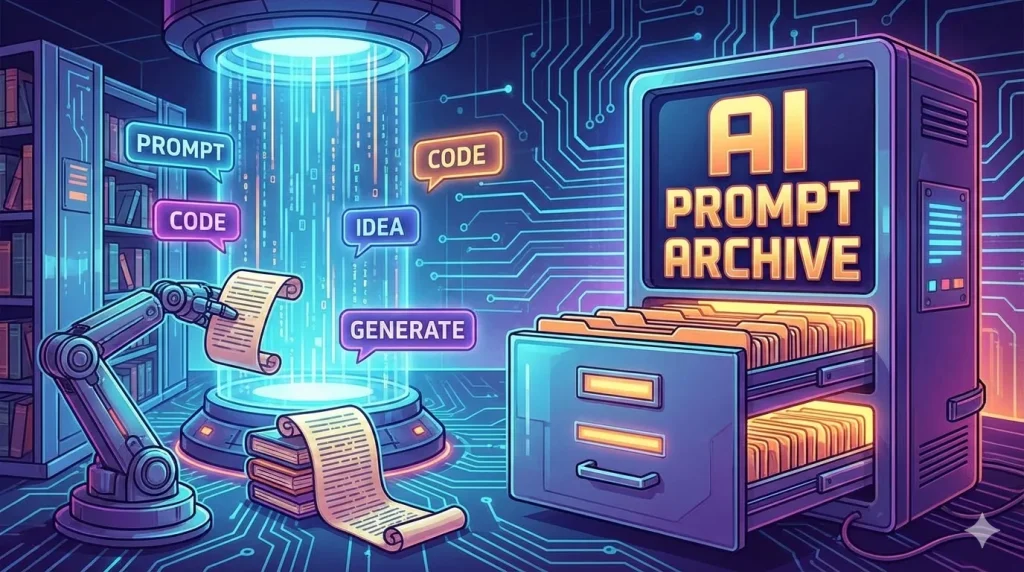
The solution isn’t just better prompting; it’s better organization. If you want to move from inconsistent guessing to predictable results, you need a centralized, organized, and searchable AI prompt archive. This isn’t optional; it’s the infrastructure of high-performing AI workflows. Ready to build your ultimate knowledge base and stop losing the magic formula? Let’s dive in.
Why You Need a Dedicated AI Prompt Archive (It’s Not Just a Spreadsheet)
Think about the intellectual property (IP) you generate every time an AI produces a flawless piece of code, marketing copy, or detailed analysis. That successful prompt—the complex structure, the perfect role assignment, the specific tone constraints—is valuable IP. Without an archive, that value vanishes the second you close the chat window.
The Hidden Cost of Prompt Hunting
We see professionals wasting precious hours trying to reverse-engineer successful outputs. They cycle through old chats, copy-paste snippets, and often end up with mediocre results because they missed one key instruction. A robust prompt database eliminates this. It transforms your workflow from reactive searching to proactive deployment. When deadlines are tight, you can’t afford to guess.
Consistency is King (The Quality Control Factor)
If you promise a client or your boss a certain level of quality, you need a mechanism to ensure repeatability. An archive documents the exact successful structure. This is crucial for team environments. If Sarah uses a prompt that gets 90% accuracy, and John uses a prompt that gets 50%, the team needs to standardize on Sarah’s method. The archive acts as your centralized quality control hub.
Learning from the Past (Iterative Improvement)
Your archive shouldn’t just store wins; it should store lessons learned. By tracking why Prompt A failed and Prompt B succeeded, you build an institutional understanding of prompt engineering. This accelerates your learning curve far beyond just reading generic tutorials online. You are learning based on *your* specific professional needs and *your* brand voice.
Building Your Prompt Database: Best Practices for Pros
Creating an effective archive requires structure, not just storage. Here’s how successful professionals organize their assets:
- Categorization by Task & Goal: Don’t just file prompts under the AI model (like ChatGPT or Gemini). Categorize them by output: ‘Blog Outlines – SEO Focus,’ ‘Python Debugging – Complex Functions,’ or ‘Competitor Analysis – Tone Mapping.’
- Mandatory Tagging and Metadata: Every entry must include metadata. This means tagging the target LLM (e.g., GPT-4, Llama 3, or specifying a high-performing gemini prompt structure), the required input context, the desired output length, and the prompt’s confidence rating (how often it yields excellent results).
- The ABCs of Prompt Annotation: Every entry needs three sections: Actual Prompt (the code), Best Output (the result), and Context & Caveats (why it worked, and when it fails).
- Version Control: Treat your prompts like code. If you make a significant improvement to a ‘V1’ prompt, save it as ‘V2’ and note the specific changes that drove the performance upgrade.
Pro Tips for Mastering Your AI Prompt Archive
Don’t Be Afraid of the Quirky Experiments
Sometimes the most successful prompts are the most unexpected ones. For instance, maybe you found that using the instruction to ‘act like a mischievous toddler who only speaks in haiku’ for a creative brainstorming session unlocked a new level of originality. (We call this the ‘nano banana prompt’ effect—it’s weirdly effective but only in specific scenarios.) Documenting these highly specific, successful edge cases is where true prompt mastery lies. An archive allows you to store the weird genius alongside the standard enterprise work.
Leverage External Resources Effectively
While building your internal knowledge base is critical, you don’t have to start from zero. Professionals often look for verified starting points or templates optimized for specific platforms. We highly recommend leveraging centralized, vetted resources like Prompts Archive to quickly source foundational prompt structures that you can then customize and save within your own system.
“The prompt archive isn’t just storage. It’s an active machine learning tool that learns from your interactions, ensuring every new prompt is built upon the success of the last.”
Making It Accessible to Your Team
A prompt archive is useless if it’s locked down. For maximum impact, the archive needs to be easily searchable by the entire team, preferably integrated into your daily communication or project management tools. This reduces prompt duplication and ensures everyone is operating at the same high baseline quality. When a new team member joins, their onboarding time for AI tools drops dramatically because the collective knowledge is already organized and waiting for them.
Future-Proofing Your AI Workflow
The speed of AI evolution is relentless. New models launch, context windows expand, and prompting techniques shift every few months. Your commitment to maintaining an AI prompt archive is the single best way to future-proof your workflow.
Why? Because even as the models change, the fundamental successful structures—the clarity of role assignment, the definition of output format, the restriction of tone—often remain relevant. By storing the high-level strategy rather than just the literal text, you maintain intellectual agility. You can quickly adapt a proven marketing prompt structure optimized for GPT-4 to work perfectly with the latest open-source model simply by tweaking the introductory syntax.
Stop wasting time reinventing the wheel. Start building your dedicated prompt archive today. It’s time to move from being an AI user to an AI workflow architect.